According to Census Records Adolphus Hardy was born between 1878 and 1882 from either Brampton, Derbyshire or Leicester depending on which census you look at. Military records state he was born in Newark, Nottinghamshire.
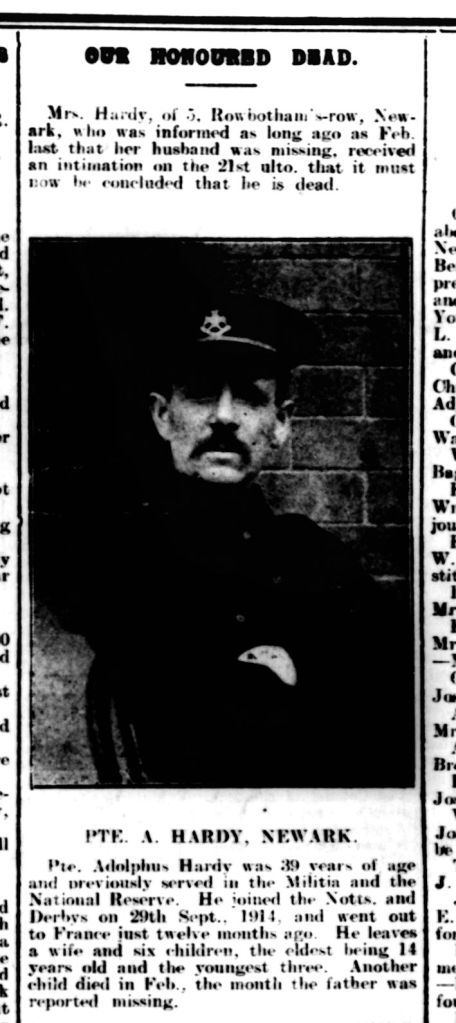
The newspaper article above is from the Newark_Herald_06_January_1917
The 1901 census shows him as Dolphis Hardy, living as a boarder at 3 Rowbothams Row, Water Lane. He’s living with his brother Edward Hardy and his family.
The 1911 census shows he was living at 5 Rowbottom Row, Water Lane, Newark with Mary Jane Brown as his house keeper. Various children are also listed, Mary, Charlotte, Adolphus, John James, and Lucy but these children all have the surname BROWN. Worth noting in the 1911 census he signs the census record as DOLPHUS HARDY
Adolphus Hardy marries Mary Jane Brown on the 15th March 1914 at The Church of St Leonard, Newark upon Trent, Nottinghamshire. His father is listed as ADOLPHUS HARDY (Deceased) Labourer.
Adolphus dies serving in the First World War on the 14th Feb 1916 details of which can be seen below:
In his service record dated 1st Sep 1914 it states all children were born before marriage, and lists those named above there can be no doubt that he was their father and they were “officially” illegitimate.
The military records are also of interest, on the 14th Aug 1919 Mary Jane Hardy, wife of Adolphus had to fill in forms regarding any known relatives. She states Adolphus had no other living relatives, no parents, siblings, grandparents or other relatives were known. And “All children of Adolphus Hardy before marriage”. This record is of interest because it’s obvious Mary Jane Hardy did know Adolphus had other family, the 1901 census clearly shows she was living two doors away from the Hardy’s. The Hardy’s were at 3 Rowbotham Row and the Brown’s at 5 Rowbotham Row. Although the 1911 census shows Edward and his family had moved away to Worksop, Nottinghamshire. The 1921 census shows Edward and his family back at Rowbotham Row, number 2, Mary is still at 5 Rowbotham Way, so why Mary states Adolphus had no extended family is a mystery, unless she thought they may have a claim on any military pension.
As stated the 1901 census indicates Adolphus did have other family and at least one brother EDWARD HARDY b.1868 d.1933, but again although records indicate Edward was b.1868 in Thorpe, Derbyshire no records can be found to prove this. Edward Hardy married Sophia Ann Cobb on 3 Nov 1890 and Edward’s father is shown as RUDOLPHUS HARDY, Labourer.
DNA links between myself and descendants of Edward Hardy prove Adolphus Hardy (senior) and Rudolphus Smith are one and the same. Rudolphus Smith was born 28 Nov 1839 and dies 14 Dec 1901.
Taken from the Commonwealth War Grave Commission web site Casualty Details:
Name: HARDY; Initials: A; Nationality: United Kingdom; Rank: Private Regiment/Service: Sherwood Foresters (Notts and Derby Regiment); Unit Text: 10th Battalion; Age: 39; Date of Death: 14/02/1916; Service No: 6412; Additional info: Husband of Mary Jane Hardy, of 5, Rowbothams Road., Water Lane, Newark.; Casualty Type: Commonwealth War Dead Grave/Memorial; Reference: Panel 39 and 41; Memorial: YPRES (MENIN GATE) MEMORIAL
Remembered on Newark, St Mary’s Church, Borough of Newark Roll of Honour War Memorial as A HARDY Notts. and Derby Regiment
Remembered on Newark Cemetery War Memorial as A HARDY
Nottinghamshire WW1 & WW2 Roll of Honour – Adolphus Hardy
===========================================================================
Extract from the War Diary of 51 Infantry Brigade, 10 Battalion Sherwood Foresters (Nottingham and Derbyshire Regiment)
Date 14th February 1916: 10th Sherwood Foresters: Casualties to 12 noon 10 R. Killed, 7 Wounded, including 3 slightly at duty. By Major J C Keown: The following report describes subsequent happenings “On the night 13th/14th Feb. The 10th Sherwoods relieved the 7th Lincolnshire Regt. In trenches F29, 30, 31, 32. All four companies occupied the front line and support trenches and there was no Battalion reserve. “On the right of the battalion were the Lancashire Fusiliers extending from NEW YEARS trench inclusive and on the left were the S. Staffordshire Regt. Occupying from trench F33 inclusive. The night was comparatively quiet and at 7a.m. I visited the trenches. At 8.30a.m. the enemy commenced an intermittent bombardment with trench mortars, rifle grenades and some guns, and in view of subsequent events this was apparently registering. This continued intermittently until 3.30p.m. when the enemy commenced a terrific bombardment on the front line and support trenches. “At 3.40p.m. a message was received at Bn. H.Q. reporting heavy shelling on the front line and supports. This was repeated to the Bde. And Artillery officers who were at Bn. H.Q. and as much retaliation was called for as could be obtained. “Communication with the front line was cut off very early but the shelling could be observed from H.Q. and the constant messages were sent to the Bde. H.Q. reporting that the shelling was still very heavy. “The retaliation commenced at about 4p.m. but was very inadequate, and poor in comparison with that which was coming over and we had great difficulty in impressing the Artillery with the seriousness of the situation. At the very height of the bombardment a message was received “Is that sufficient” “The Company Commanders, although anticipating an attack, considered through information brought back to them by Officers Patrols, that it would be useless to send up any more men as the front trenches were battered to the ground and most of original garrison incapacitated. “At 5.40p.m a mine appears to have been exploded in trench 31 and almost immediately the bombardment lifted and was directed to reserve wood. “The Germans preceded by a large number of bombers, who from some accounts were dressed in Khaki, with white bands on their right arms, jumped into our front line trenches as the guns lifted and must have been well across ‘No Man’s Land’ before the bombardment lifted. “Finding little or no resistance in the front lines the enemy continued to advance both over the open and down the communication trenches, but were held up by our troops in the support trenches. “About this time (5.40p.m) a messenger arrived at Bn HQ. Very exhausted and excited saying that the Germans were coming down the ‘lane’. This was confirmed almost immediately by others so it was decided to occupy an old trench running from just below Bn. HQ. Across the direction of CHESTER FARM, and a messenger was sent to the detachment of the 7th Lincolnshire Regt. Who were in SPOIL BANK DUGOUTS informing them of the situation. The two companies were not under my command but at my invitation came up to reinforce the support lines. “I was then informed by the Bde that these two companies of the 7th Lincolnshire Regt and a company of 7th Border Regt were being placed under my command for a counter attack: but I advised the Bde to send the whole Border Regt (which was done) as I considered that the enemy had had too much time to consolidate for the counter attack to be successful with so small a force. “To this they agreed and Lt. Col. Norrington arrived with the remainder of this battalion at about 10p.m. and took over command of the sector. The counter attack was not successful.
(Sd) J.C. Keown Major 10th Sherwood Foresters.
This extract clearly shows a sustained attack by the Germans from which Adolphus Hardy didn’t survive.
 Wayne and Sandra's Family History