The Standard Saturday January 24, 1925
STOLEN LIFE-BUOY ROPE. Coroner’s Comments at Boston Inquest.
ACCIDENT AT THE DOCK.
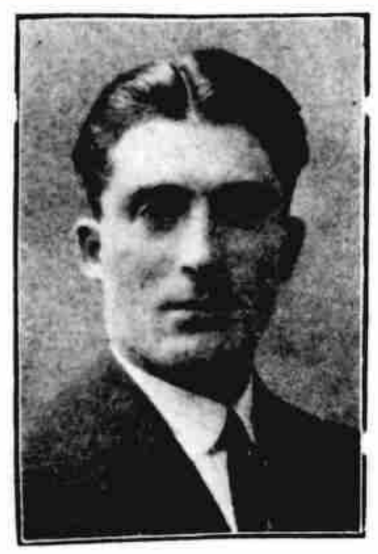
THE LATE CLARKE GRAY, of Great Hale.
At the Boston Poor Law Institution on Saturday afternoon the Boston and District Coroner (Dr. R. Tuxford) held an inquest—sitting without a jury—on the body of Clarke Gray (28), a single man living at 17 Oxford-street, who was drowned in the Dock the previous Thursday evening. Attending the inquiry were Mr. E. Waite (for the Dock and Harbour Commissioners), Inspector Garbutt, Lincoln (L.N.E.R.), Mr. W. J. Mouncy (Goods Agent), Mr. A. G. Townsend (Acting Dock Manager), Mr. H. Stewart (the Loco. Department), and Mr. C. Harris (National Union of Railwaymen). Tom Gray, of Great Hale, gave evidence of identification. He stated that he last saw his son alive on January 7th, when he appeared to be in the best of health. He had been in the employ of the Railway Company for 12 years, for the last three of which he had been an assistant shunter at the Dock. Walter Robinson, 23, Sydney-street, yard foreman, attached to the dock staff of the L.N.E.R., stated that on January 15th he went on duty at about two o’clock and was in charge of the shunting there. At about 5.30 he told shunters Martin and Gray to set waggons ready near the Thomas Wood-stowe, a screw steamer, which was unloading kainite. At six o’clock he saw some empty trucks “picked up” from the granary road and taken onto the bridge, and he went to the north end to protect the level crossing there. He saw waggons alongside the steamer. Gray came near him and witness remarked: “I do not think they are enough.” Gray replied: “I think they are all right.” Witness said: “I will go and see how many empty waggons there are available in the road.” Gray walked on, and that was the last witness saw of him; he was carrying a lamp and a pole. Witness was going east when he heard cries of distress, and returning found that a boat had been taken into the water. The Coroner: Was the place more dark than usual? Witness: About the same. Mr. Harris: What is the distance between the rail and the edge of the dock? Witness: I should say about 4ft. What is the overlapping of the waggon from the rail? — About 18 inches. Is shunting possible on the other side of the waggons? — No. It all has to be done from the dock side? — Yes. Do shunters have to walk on an iron plate? — Yes. I take it there are rings there? — Yes. Are there any lights on that side of the rail? — No. No fixed lights at all? — No. Were you there when a life-buoy was obtained? — No. Did you see a life-buoy? — No. George Wakelin Cox, of Park-road, Skirbeck Quarter, in the employment of the railway company as an engine driver, said that on Thursday he went on duty at 12.30, and he proceeded to do certain shunting with Martin as shunter and Gray as the latter’s assistant. At 5.50 he was required to shunt 15 or 16 waggons along the “tin tab.” The waggons were uncoupled by Martin, and witness “knocked” them down the line, bringing the engine to a stand-still near the big arc light between the Hamburg sheds and the transit shed. He heard Martin call out and ask if the waggons had gone far enough, but he did not hear a reply. Two or three minutes later there was a cry as though someone was hurt. He thought he heard Martin say that someone was in the dock, and he told the fireman. Both got down from the engine, and witness ran for a life-buoy, which was on the arc lamp referred to. He looked into the water, but failed to see any sign of the deceased. Someone obtained a boat, and dragging operations commenced. He remained at the spot until the body was recovered about an hour later. At the point the deceased had had tea together, and the latter appeared to be well and in the best of spirits. The Coroner: What did you do with the life-buoy? Witness: I kept it in my hand. Did you not throw it for him? — No, I did not know the spot at which he might come up. Was there a rope attached to the life-buoy? — No. Was it more dark than usual? — It was a dark night. I have been there when it has been as dark as that before. Have you been a shunter there long? — I have been shunting 18 months. Is the surface bad and off? Mr. Harris: As an experienced man do you think lighting is necessary on that side of the waggons were shunting is taking place. Witness: Yes. Are the arc lamps which do exist any use in shunting? — Yes, at the spot where the man was working. Sidney Smith, 24 Duke-street, Boston, employed by the railway company as a fireman, said during the shunting operations he did not see Gray as he (Gray) was working on the driver’s side. The Coroner: Which side would that be? Witness: On the side of the dock. Continuing, witness said Cox got a life-buoy. He looked into the water and could not see anyone. He heard someone say something about getting a boat. He noticed that the water was near the top. The night was dark, but the usual lights were burning. At the spot where Gray fell into the water there were no waggons or any obstruction, and he could have walked in the 4ft. way had he desired to do so. Walter Martin, shunter, said he was on duty for some time during Thursday with deceased, who was working as his assistant. Witness uncoupled eight or ten waggons and these were shunted so that the work of unloading the steamer might be proceeded with. He could see no lamp near the place where the waggons should have stopped, but as he saw a light, which was some distance from the ground he concluded that Gray was returning. He had intended to wait for deceased when he heard cries from the direction in which the latter had gone. He walked back, but could not see Gray; nor did he see him in the water. Smith obtained a boat at once; the boatman came up and they went to look for the Goods Agent. Witness could not account for Gray falling into the dock unless he caught his foot in something or stumbled. At the point where he had seen the light there was no truck. There was a considerable amount of space between the engine and the truck and the waggons they had left in position; and deceased’s lamp was in the water. The Coroner said he would like some information as to the space between the rails, looking at the waggons and the edge of the dock, and Mr. Waite said he would call Mr. Townsend, the acting manager. Mr. A. G. Townsend, of Park-road, Skirbeck Quarter, told the Coroner that the distance between the rail and the edge of the dock was, at the point where the man fell in, 4ft. 10ins. Between the edge of the dock and the rail there is a flat iron plate? — Yes; it is seven inches wide. How far would that be from the edge of the dock? — Two feet. That is to cover up some pipes, I think? — No, for the crane to run along. Are you responsible for the light on the dock? — Yes. This lighting has been in existence for some years? — Yes. Has there been any complaint as to inefficient light before? — No complaint. Mr. Waite asked some questions relative to the lights, presenting to Mr. Townsend a plan of the scene of the accident; and witness stated that there were two arc lamps, one of which was at the north-eastern corner of the docks and shone straight along the quay. It was within 200ft. of where the accident took place. The other was between the Hamburg shed and the transit shed. The Coroner: Were you about the dock that night? Witness: Yes. Were you far away when the accident took place? — I was there at about 6.20 when the dragging operations were in progress. Mr. Waite asked him if came about that there was no rope attached to the life-buoy taken by Cox taken from the arc lamp. Mr. Townsend replied that no doubt it had been stolen, and probably that day. Have you had trouble over the stealing of ropes before? — Yes. Mr. Waite remarked that it seemed a dastardly thing that people should steal the rope from the life-buoy. Mr. Harris: Do you think that if that dead end line of waggons did not hang between the Hamburg shed and the transit shed it was good to shunters working on the opposite side of the waggons. Mr. Townsend: Yes, that is why it is placed there. He said he had walked to the spot where Gray fell into the water without a lamp. You said you had no complaint about lighting. I take it that if a railway man wanted to make a complaint he would make it to the railway officials? — I do not know. The men know me pretty well, but they have not come to me. But that would be the proper method for them to employ? — Undoubtedly. P.c. Sykes deposed that at the police station at 6 p.m., on Jan. 15th, he was instructed to go to the dock where it was reported a man had fallen into the water; he assisted in grappling. At 7 p.m., the body was recovered. The evidence of Dr. W. E. M. Wright, who made a post-mortem examination of the body, was that with the exception of a superficial abrasion below the right knee-cap there was no mark of violence. Death was due to drowning. The Coroner: You do not think the man had any injury to the head causing concussion? Witness: No. Mr. Waite asked if the abrasion was quite recent, and Dr. Wright replied “Absolutely.” Could it have been caused by his tumbling? — Yes, I take it that it was caused by stumbling. The Coroner said this was a particularly sad case of a man in the prime of life who fell into the dock and was drowned. He (the Coroner) had had a post-mortem examination of the body to be quite clear that deceased was not knocked down by the engine or a waggon into the dock. “I think it is quite clear,” remarked Dr. Tuxford, “that there was sufficient light on the dock at that time of night, and it is the absolute, usually supplied. Shunting has been going on there for a considerable number of years without mishap. Probably the man slipped on the iron plate, slipped into the dock and was drowned.” With regard to the life-buoy, even if it had been given to the man there would have been no rope to assist him. One could not express sufficient condemnation of people who did such a thing as taking away a rope from a life-buoy. His verdict was that death was due to drowning caused through misadventure.
The late Mr. Clarke Gray was born at Great Hale and at one time was a chorister at the Parish Church there, and four of his brothers are still members of the choir. He joined the service of the G.N.R. in 1911 as a lad porter, and after a few months at Dogdyke Station went to Heckington. He was transferred to Sutton-on-Sea in May, 1920, as porter. In the Great War (joining up on August 23rd, 1914) he served with the Lincoln Regiment, was demobilised in 1918. He then returned to Sutton-on-Sea to his former job. He was transferred to Boston Docks at end of the summer of 1922.
THE FUNERAL. The interment took place at the Parish Church, Great Hale, on Monday afternoon. The service, both at the Church and at the graveside were conducted by the Vicar (the Rev. F. McKenzie). The cortege was met at the church gates by the surpliced choir, and both services were choral. The anthems, “I know that my Redeemer liveth and “O Rest in the Lord,” and the hymn “On the Resurrection morning”, were sung, and the choir, which preceded the remains from the church to the graveside, rendered the hymn “Now the labourer’s task is o’er.” Twenty of deceased’s fellow workers lined the path to the church as the coffin was carried in, and six others acted as bearers. Mr. Reddick, Heckington stationmaster, and four of the staff, and Mr. Mouncy, Goods Agent, Boston, were also present. The chief mourners were:—Mr. and Mrs. T. Gray (father and mother), Miss Lydia Gray (sister), Felix, Tom, William, Leslie, Sydney, Eric and Ernest Gray (brothers), Mrs. William Gray, Sleaford (sister-in-law), Miss Woodcock (fiancee), Mr. and Mrs. Felix Brackenbury, Heckington (cousins), Mrs. Hipkin (aunt), Mrs. Greetham, Swineshead (cousin), Miss Barton (Donington), Mr. D. Warrington (Boston), Mrs. Dudley (Heckington), Miss E. Smith (Heckington), Mrs. Webb (Boston), Mr. Darling (Boston), Mrs. George and Clarke Gray (Great Hale), Mr. Reg Creak (Boston), Mr. and Mrs. J. Moore (Boston), and Mrs. Page (Boston). A number of friends were also present at the graveside. Floral tributes were sent from:—All at Home; Maud; fellow-workers at Boston Docks, L.N.E.R.; fellow-workers at Boston Goods Dept., L.N.E.R.; Mary; Mr. and Mrs. Woodcock and family, Ballhouse; Edie, Alf., Cecil, and Reg, Boston; Mr. and Mrs. J. Moore, Boston; L.N.E.R. staff, Heckington; Elsie; Leslie; Grimsby; Mr. and Mrs. G. Page, Boston; the Sutton-on-Sea station staff, L.N.E.R.; S. Wood and family; all at 17 Oxford-street, Boston; Charlie and Charlotte; Cousin; Felix and Cis; Mr. and Mrs. Lilley and family.
Here are the detailed profiles you can extract from this document:
Principal Individual:
- Name: Clarke Gray
- Role in Document: Deceased (Subject of the inquest and obituary)
- Biographical Details:
- Age: 28 years old.
- Marital Status: Single.
- Residence: 17 Oxford-street, Boston.
- Occupation: Assistant shunter at the Dock. Employed by the Railway Company (L.N.E.R. / formerly G.N.R.) for 12 years, the last three at the Dock. Started as a lad porter in 1911.
- Birthplace: Great Hale.
- Death: Drowned in the Dock on Thursday evening, January 15th (year likely 1925 based on context). The coroner ruled it an accidental death due to drowning caused by misadventure (slipping on an iron plate).
- Military Service: Joined the Great War on August 23rd, 1914. Served with the Lincoln Regiment in France. Demobilised in 1918.
- Other Details: Former chorister at the Parish Church in Great Hale. Transferred to Sutton-on-Sea in May 1920, then to Boston Docks at the end of summer 1922.
- Relationships: Son of Tom Gray and Mrs. T. Gray. Brother to Lydia, Felix, Tom, William, Leslie, Sydney, Eric, and Ernest Gray. Fiance to Miss Woodcock.
Associated Individuals:
- Tom Gray: Father of the deceased. Resided in Great Hale. Identified the body.
- Dr. R. Tuxford: Boston and District Coroner who conducted the inquest.
- Walter Robinson: Yard foreman, 23 Sydney-street. Attached to the dock staff of the L.N.E.R.
- Walter Martin: Shunter, who was working with the deceased at the time of the accident.
- George Wakelin Cox: Engine driver, Park-road, Skirbeck Quarter. Attempted to use the life-buoy.
- Sidney Smith: Fireman, 24 Duke-street, Boston. Assisted in the search.
- Mr. A. G. Townsend: Acting Dock Manager, Park-road, Skirbeck Quarter.
- P.c. Sykes: Police constable who assisted in grappling and recovered the body at 7 p.m.
- Dr. W. E. M. Wright: Police surgeon who performed the post-mortem examination.
- Rev. F. McKenzie: Vicar who conducted the funeral service at the Parish Church, Great Hale.
- Miss Woodcock: Fiancee of the deceased, listed among the chief mourners.

 Wayne and Sandra's Family History